Six Temperatures to Candy Glory: A Home Cook's Field Guide to Cooked Sugar
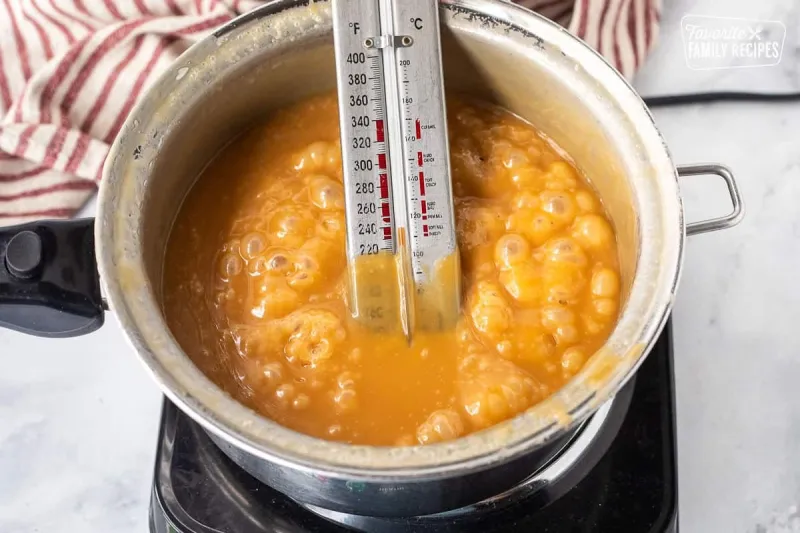
Photo: candy thermometer boiling sugar syrup saucepan homemade caramel, via www.favfamilyrecipes.com
We hear from a lot of readers who've decided this is the year they make their own holiday candy — the caramels for the gift boxes, the brittle for the cookie platter, the divinity their late grandmother somehow made without a thermometer. And we hear from just as many who tried once, set off the smoke alarm, and quietly went back to buying.
This one's for the second group. Because here's the secret the pros don't lead with: candy making isn't about skill. It's about temperature. Full stop. Once you understand what sugar does at each stage of the climb, the whole craft stops being mysterious and starts being a recipe.
First, the Equipment (There's Not Much)
You need exactly four things:
- A heavy-bottomed saucepan. Thin pans create hot spots, and hot spots scorch sugar before the average temp ever reads right.
- A reliable candy thermometer. Clip-on or digital, just test it first: stick it in boiling water. It should read 212°F. If it doesn't, note the difference and adjust — every thermometer has opinions.
- A pastry brush and a cup of water. Sugar crystals on the side of the pan cause the whole batch to crystallize into a gritty mess. A quick brush of water down the sides prevents it.
- Patience you didn't know you had. Sugar goes from 240°F to ruined in about ninety seconds. You do not walk away. Ever.
The Six Stages, and What They're For
Thread (223–235°F). Syrup that forms thin threads when drizzled from a spoon. You'll know it from glazes and from the syrup base of old-fashioned preserves. Barely cooked, barely interesting — but it's the on-ramp.
Soft Ball (235–240°F). Drop the syrup into cold water and it squishes into a ball that flattens when you poke it. This is fudge and fondant territory: soft, scoopable, tender. It's also where fondant-centered chocolates get their silky interior.
Firm Ball (245–250°F). The cold-water ball now holds its shape but still gives under pressure. This is caramel's true home — chewy, pliable, perfect. Which brings us to the anxiety zone.
Hard Ball (250–266°F). The ball is dense and slightly tacky, like a gummy with ambition. Nougat, divinity, and rock candy all live here. Two degrees hotter and your nougat turns to glue; two degrees cooler and it never sets.
Soft Crack (270–290°F). Threads in cold water bend before breaking. This is taffy — stretchy, chewy, pullable. It's also where butterscotch's rich, amber depth gets built.
Hard Crack (300–310°F). Threads snap like glass. Brittle, lollipops, and toffee all live here, past 300 degrees, where sugar turns a gorgeous golden and hardens into glass within minutes of leaving the pan.
The Middle Zone: A Love Letter and a Warning
If you've had a candy disaster, odds are it happened between 240 and 260°F — the caramel corridor. It's the anxiety-inducing middle of the thermometer because it's where cream, butter, and sugar all have to cooperate, and because the window between "perfect chew" and "tooth-cracking stone" is a razor-thin few degrees.
Our rules for surviving it:
- Pull the pan off heat 2 degrees early. Residual heat keeps cooking the sugar; carryover is real.
- Use a heavy pan on medium, never high. Rushed sugar burns at the bottom while the top still reads fine.
- Trust the cold-water test over the thermometer if they disagree. Your grandmother's method survives for a reason.
- Humidity is the enemy. On a muggy August day, caramels weep and brittle goes sticky. Dry winter days — conveniently, exactly when you're making holiday gifts — are candy's best friend.
What to Make First
Start at hard crack with peanut brittle. It's forgiving, it's fast, and it teaches you how fast sugar moves at 300°F better than any tutorial. Once you've nailed that, climb down the thermometer: toffee at soft crack, nougat at hard ball, and finally — the graduation exam — a batch of soft, salted caramels at firm ball, wrapped in wax paper squares and destined for every gift box you hand out this year.
The first batch you get right will taste better than anything on a store shelf, partly because it's fresh and partly because you'll have earned it, one degree at a time.